A Quick Guide for Machine Learning
井民全, Jing, mqjing@gmail.com
Google doc: This Document
Back to the Main Page
Purpose
這份文件描述如何在最短時間內進入 Machine Learning 的領域. 我還是初學者, 我也在學習, 所以請專家多多包涵, 這是一篇遺漏很多的指南.
備忘錄
這份 quick guide 主要是以 Google Tensorflow 為主, 但 Machine Learning Framework 不只有 Google 的 tensorflow, 還有 Facebook AI research Group 開發的 Torch, 再來是微軟研究院的 CNTK 和 Caffe,. 另外, 還有一個重要的網站 OpenAI 必須瀏覽, 這是由 Elon Musk 投資的重要非營利人工智慧研究公司. 裡面有一個公開的人工智慧研究開發平台 OpenAI Gym, 這裡面有許多 toolkit 以及非常有價值的文件, 可提供學習.
文件大綱與目錄
你必須會最簡單的 Python
網路上有一大堆 Python 的教學文件, 你隨便搜尋都可以找到. 以 Machine Learning 應用來說, 最常使用的還是 影像處理. 你可以參考我寫的 Python + OpenCV 的文章, 可以在 10 分鐘內建立 python + OpenCV 開發環境
選擇 Machine Learning framework
其實現在最熱門的就是 Google 的 TensorFlow, 我們從 GitHub 的統計資料 (見下圖) 也可以看得出來. 使用 TensorFlow 來開發的專案數量幾乎是第二名 Torch 的兩倍, 這表示如果你遇到問題時, 可能比較有機會能獲得解答.
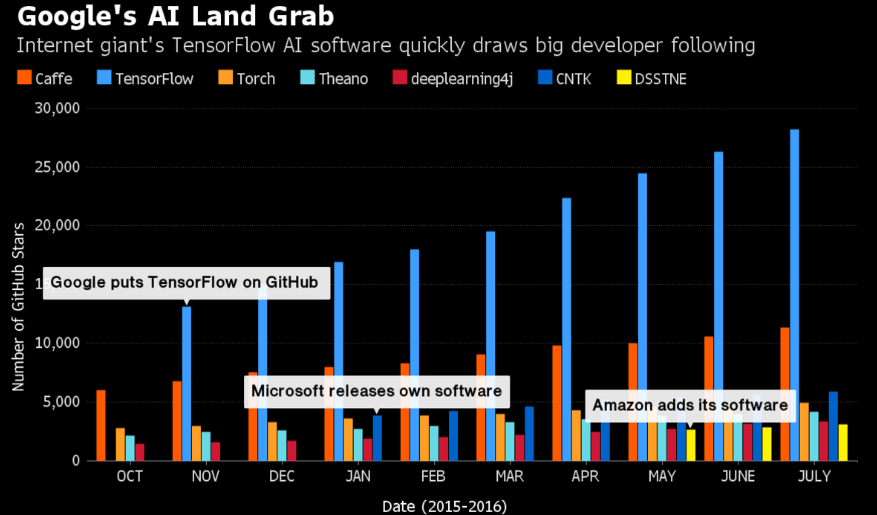
Fig. GitHub 上使用 Machine Learning Framework 的專案統計數量.
安裝 AI 開發工具
首先你要先知道, 用什麼工具來實現你的 AI 應用程式. 最簡單的方式就是使用 Google 的 tensorflow 搭配 Anaconda Pythone 開發環境. 你可以用下面我寫的教學文件在 20 分鐘內, 不需要動頭腦思考的方式, 完成安裝開發環境的工作.

直接開始寫數字辨識 tensorflow code
我的習慣是先看到 code, 然後我照著做, 它會動. 那麼我才會相信這東西可以用. 你可以按照我寫的文件, 一步一步在兩個小時內完成所有 tensorflow 初學者第一個會寫的程式. 完成後, 你會建立無比的信心, 繼續往更近一步的理論前進.


機器學習的理論
在學會怎麼使用 tensorflow 解決手寫數字的問題後, 你應該要針對機器學習的理論開始研究, 下面我列了幾個不錯的網站, 內容從簡單開始.


雜項
Mindset
- [ml, feature] use “learning” algorithms which aim to learn the features, without any assumptions
- [ml, feature, classifer] 人類仔細挑選 "good" feature, 使用簡單的 classifer 分類. 機器挑選 feature (甚至使用原資料), 使用非常複雜的 classifer
- [ml, description] 機器學習是找規則, 進行預測
- [ml, description] 從資料出發, 要算出 g, 接近真實 f
- [ml, hypothesis set] 從一堆 hypothesis 裡面 (h1, h2,... hn) 的參數調整, 產生結果
- [data mining] 找出有趣的東西
Resource/Competition
- 大數據競賽平台, https://www.kaggle.com/
數據科學家可在其上進行競賽,提供潛在的解決方案. 涉及領域涵蓋了計算機科學、計算機視覺、生物、醫藥、甚至冰川學等等. 每個月Kaggle論壇有超過4,000條新帖子,每天Kaggle比賽有超過3,500次提交.
- 國際知識發現和數據挖掘競賽, http://www.kdd.org/kdd-cup
- 國內人工智慧協會比賽, https://taai-test.herokuapp.com/award/winner
- Facebook AI Researc, https://research.fb.com/category/facebook-ai-research-fair/
Paper
Database
- Activity: jogging, walking, ascending stairs, descending stairs, sitting and standing
- 36 users using a smartphone in their pocket with the 20Hz sampling rate (20 values per second)
- The dataset consists of 60000 32x32 colour images in 10 classes, with 6000 images per class. There are 50000 training images and 10000 test images.


- The MNIST database of handwritten digits, available from this page, has a training set of 60,000 examples, and a test set of 10,000 examples. It is a subset of a larger set available from NIST. The digits have been size-normalized and centered in a fixed-size image
 |  |
Image Processing


- [image, contour, CHAIN_APPROX_NONE] How to use APPROX_NONE mode to get the contour from an image (view)


